ESP32 vs ESP8266: Specs, Differences and Which to Pick
ESP32 vs ESP8266 compared on cores, SRAM, GPIO, ADC, Bluetooth and sleep current from the datasheets, plus when the ESP8266 still makes sense.
- Author
 Mauro Brambilla
- Published
- Reading time
- 6 min
- Category
- Comparisons
In short
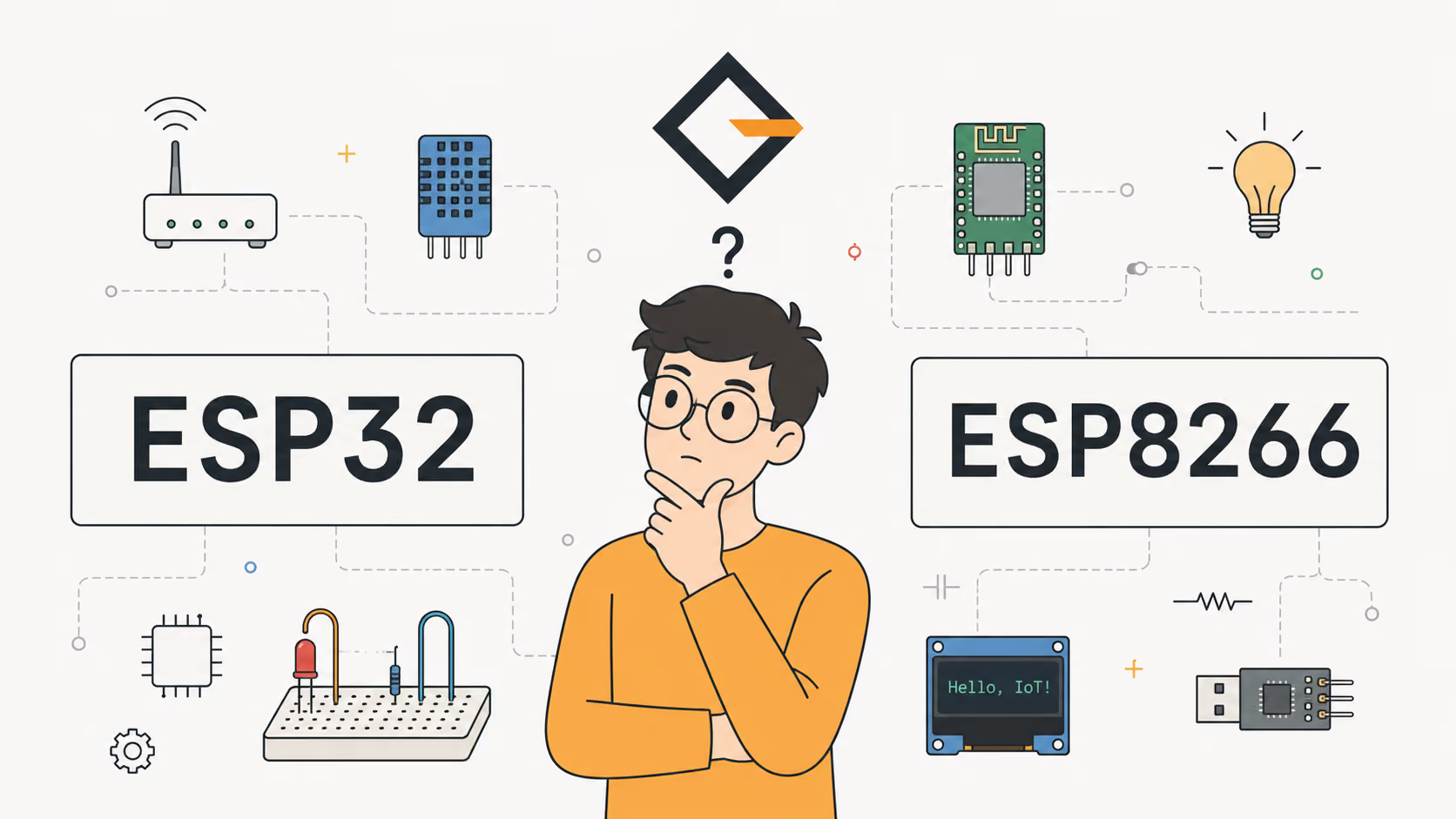
Pick an ESP32 for new projects: up to two 240 MHz cores, 520 KB of SRAM and Bluetooth. The ESP8266 is one 160 MHz core, Wi-Fi only, and Espressif marks it NRND.
Pick an ESP32 for any new project. The ESP32 has up to two 240 MHz cores, 520 KB of SRAM, 34 GPIOs, and Wi-Fi plus Bluetooth. The ESP8266 is a single-core, Wi-Fi-only chip that Espressif now marks "not recommended for new designs". It still fits existing firmware and very small Wi-Fi nodes, and the rest of this post tells you where the line is.
Both chips come from Espressif, and on a breadboard they look like twins: a cheap 3.3 V board, a USB cable, the same Arduino sketch for blinking an LED. The differences show up later, when you want to read two analog sensors, keep a TLS connection open while serving a web page, or add Bluetooth setup. Every number below comes from the ESP32 datasheet and the ESP8266EX datasheet, and I've built all three OpenGizmo projects on the ESP32 family, so I'll say where that mattered.
How do the ESP32 and ESP8266 compare on paper?
A system on a chip (SoC) puts the CPU, memory, radios and peripherals in one package; the ESP32 and the ESP8266EX are both SoCs, and the table compares the chips themselves, not any dev board built around them. If "microcontroller" is a new word, what a microcontroller is covers it first.
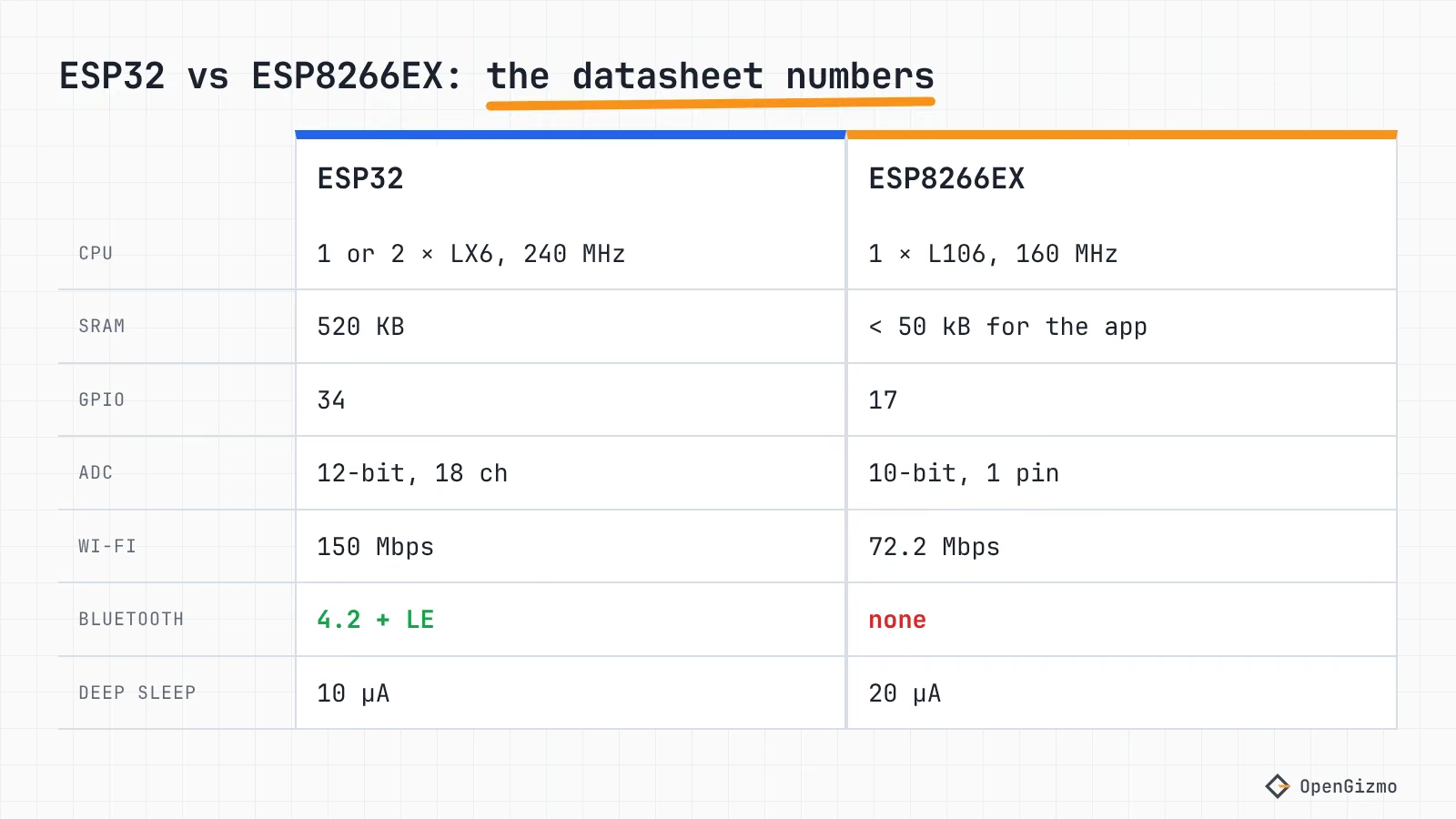
| Spec | ESP32 (original) | ESP8266EX |
|---|---|---|
| CPU | Xtensa LX6, 1 or 2 cores | Tensilica L106, 1 core |
| Max clock | 240 MHz | 160 MHz |
| SRAM | 520 KB | Under 50 kB left for your program in station mode |
| GPIO | 34 programmable, 6 input-only | 17 pins |
| ADC | 12-bit SAR, up to 18 channels | 10-bit SAR, 1 pin, 0 to 1.0 V |
| DAC / touch | 2 × 8-bit DAC, 10 touch sensors | None |
| Wi-Fi | 802.11 b/g/n, 2.4 GHz, up to 150 Mbps | 802.11 b/g/n HT20, 2.4 GHz, up to 72.2 Mbps |
| Bluetooth | 4.2 BR/EDR + Bluetooth LE | None |
| Deep sleep | 10 µA (RTC timer + RTC memory) | 20 µA, measured at 2.5 V |
| Supply | 2.3 V to 3.6 V | 2.5 V to 3.6 V |
The figures are from the ESP32 datasheet v5.3 (the feature list and its power table) and the ESP8266EX datasheet v7.1. Three of them deserve a second look.
RAM. The ESP8266EX datasheet says the memory available to users is "RAM size < 50 kB" when the chip is a Wi-Fi station connected to a router. That heap has to hold your web server, JSON buffers and any TLS session, which is why HTTPS clients on this chip are a constant balancing act. The ESP32's 520 KB of SRAM is roughly ten times that, and boards with external PSRAM add more.
Analog input. The ESP8266EX has one ADC, on the TOUT pin, and the datasheet gives it an input range of 0 to 1.0 V. Two analog sensors mean an external ADC chip. The ESP32 has up to 18 channels, but they come with a catch: ESP-IDF's ADC documentation notes that ADC2 is also used by Wi-Fi, so sensors you read while Wi-Fi is on belong on ADC1 pins (GPIO32 to GPIO39 on the original ESP32).
Sleep current. The datasheet lists 10 µA against 20 µA, but chip numbers aren't board numbers: a dev board's USB bridge and regulator usually draw far more. ESP32 deep sleep current, chip versus dev board goes through where the microamps go.
Is the ESP8266 still worth buying in 2026?
Espressif has not discontinued the ESP8266, but as of November 2026 it treats it as a legacy part. The ESP8266EX datasheet (version 7.1, dated 2025.11) carries an NRND stamp on its pages, and its revision history says the product marketing status was updated to Not Recommended for New Designs. NRND means just that: the product hasn't been discontinued, but Espressif no longer recommends it for new designs. The longevity commitment page lists the ESP8266 with an "at least 15 years" commitment starting January 1, 2014, which works out to at least 2029 (my arithmetic: the page doesn't print an end year). Espressif's site menu also suggests upgrading to the ESP32-C2 (ESP8684).
For you, that means the chip won't vanish tomorrow, and a board with an ESP8266 will keep working for as long as you keep powering it. It also means a new product design shouldn't depend on it, and that tutorials, libraries and answers will slowly drift toward the ESP32 family. The community Arduino core for ESP8266 is still on GitHub with its latest release listed as 3.1.2; I didn't check its release date. I couldn't verify retail stock or prices for either chip, so there's no price column here: check a current listing before you decide.
When does the ESP8266 still make sense?
Keep the ESP8266 when the firmware already works and the hardware isn't the problem. Rewriting a sketch that has run a relay for years, only to move to a newer chip, spends your time on a risk you don't have. It also fits when you're repairing or cloning an existing device built around it, or when the job is genuinely small: one sensor, one Wi-Fi POST every few minutes, a pin or two.
- Existing ESP8266 firmware that works and has no new requirements
- Replacing a dead board in a device that already uses an ESP8266
- A single-sensor Wi-Fi node with one analog input at most, 0 to 1.0 V
- A small sketch that fits comfortably in under 50 kB of heap
Even for a small node, the ESP32-C3 is also a single core and runs 2.4 GHz Wi-Fi like the ESP8266, so a new build gives up nothing in simplicity by choosing it.
When should you pick an ESP32 instead?
Choose an ESP32 family chip as soon as one of these applies:
| You need | Why the ESP8266 can't | Pick |
|---|---|---|
| Bluetooth or BLE setup | No Bluetooth radio at all | Any ESP32 family chip |
| Classic Bluetooth, DAC output | Only the original ESP32 has BR/EDR and DACs | ESP32 |
| A camera module | I found no PSRAM or camera interface in the ESP8266EX datasheet | ESP32 (AI Thinker ESP32-CAM) |
| Two or more analog inputs | One ADC pin, 0 to 1.0 V | ESP32 or ESP32-S3 |
| A web server plus HTTPS client | Under 50 kB of heap in station mode | Any ESP32 family chip |
| Built-in USB (no USB-serial chip) | No USB in the datasheet: boards add a USB-serial chip | ESP32-S3 or ESP32-C3 (USB OTG only on the S3) |
| Wi-Fi and sensors on separate cores | One core, and the datasheet leaves 80% of it to your code | ESP32 or ESP32-S3 |
Here is how that played out in the OpenGizmo firmware. The Gizmo Ticker and the Gizmo Reolink Switch run on the Seeed Studio XIAO ESP32-S3, and each serves a web app, answers a captive portal and makes HTTPS requests (to the CoinGecko API and to the Reolink NVR respectively). Their platformio.ini files, for example the ticker's, pin espressif32 @ 8.0.0 with the seeed_xiao_esp32s3 board. The Gizmo Camera uses the AI Thinker ESP32-CAM, and its platformio.ini selects the esp32cam board for its PSRAM, which holds the camera frame buffers. I haven't tried to port any of them to an ESP8266, so I can't tell you where one would first run out of room; the numbers above say the heap would be the first suspect.
Which ESP32 replaces an ESP8266?
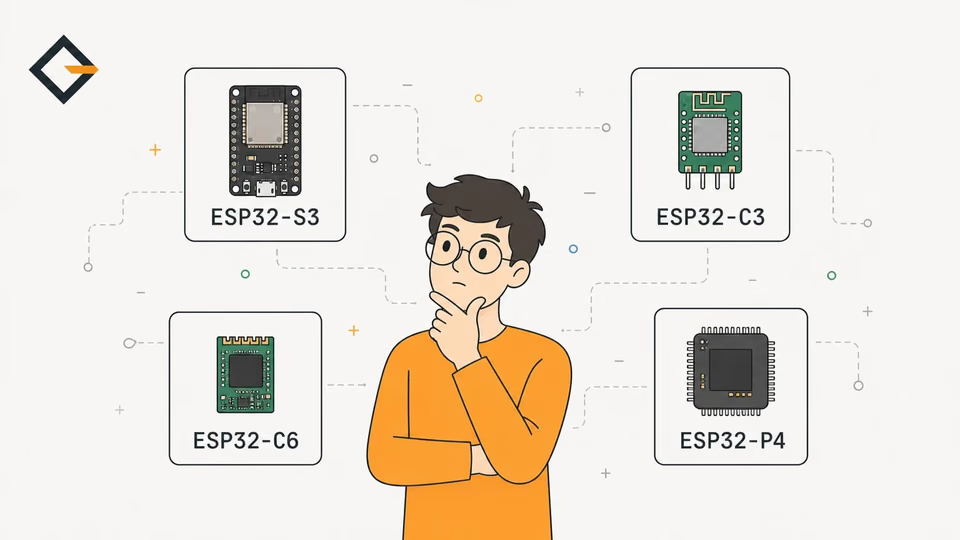
"ESP32" is a family, not one chip, and the original ESP32 is only one of four sensible picks. This table puts the candidates next to each other; the numbers come from each chip's datasheet.
| Chip | CPU | SRAM | GPIO | Radios | Deep sleep |
|---|---|---|---|---|---|
| ESP32 | 2 × LX6, 240 MHz | 520 KB | 34 | Wi-Fi 4, Bluetooth 4.2 + LE | 10 µA |
| ESP32-S3 | 2 × LX7, 240 MHz | 512 KB | 45 | Wi-Fi 4, Bluetooth 5 LE | 7 µA |
| ESP32-C3 | 1 × RISC-V, 160 MHz | 400 KB | 22 | Wi-Fi 4, Bluetooth 5 LE | 5 µA |
| ESP32-C2 (ESP8684) | 1 × RISC-V, 120 MHz | 272 KB | 14 | Wi-Fi 4, Bluetooth 5.3 LE | 5 µA |
Read the GPIO column as the chip's maximum: the datasheets note that some package variants use pins for in-package flash, so a given module exposes fewer. The sources are the ESP32-S3, ESP32-C3 and ESP8684 (ESP32-C2) datasheets.
The ESP32-C2 is Espressif's own suggestion, but it has the least RAM and the fewest pins of the four, and the ESP32-C3 is the one most boards use. For a straight swap of an ESP8266 sketch, I'd start with the C3. For a project that serves a web app, calls HTTPS APIs and drives a display, I'd start with the S3, as the OpenGizmo projects do. The longer reasoning is in which ESP32 chip you should buy, and the three XIAO boards are compared in XIAO ESP32-S3 vs C3 vs C6.
Is the ESP32 harder to program than the ESP8266?
No, for the basics. Both chips run in the Arduino framework, and PlatformIO supports both through its Espressif 32 and Espressif 8266 platforms. If you haven't chosen a toolchain yet, Arduino IDE vs PlatformIO for ESP32 compares them.
Porting an ESP8266 sketch is usually a short job: WiFi.h replaces ESP8266WiFi.h, and the web server and mDNS libraries have ESP32 versions. Pins are where you need care, on both chips. The ESP8266EX datasheet says GPIO0, GPIO2 and MTDO (GPIO15) select the boot mode, so what you wire to them at power-up matters; the ESP32 has its own strapping pins, which this guide lists chip by chip. One more difference: the datasheet maps GPIO6 to GPIO11 to the external SPI flash on the ESP8266EX, so six of the 17 pins aren't free on a real module, and a dev board may expose fewer than you expect. Check your board's pinout, not just the chip's.
So which one should you pick?
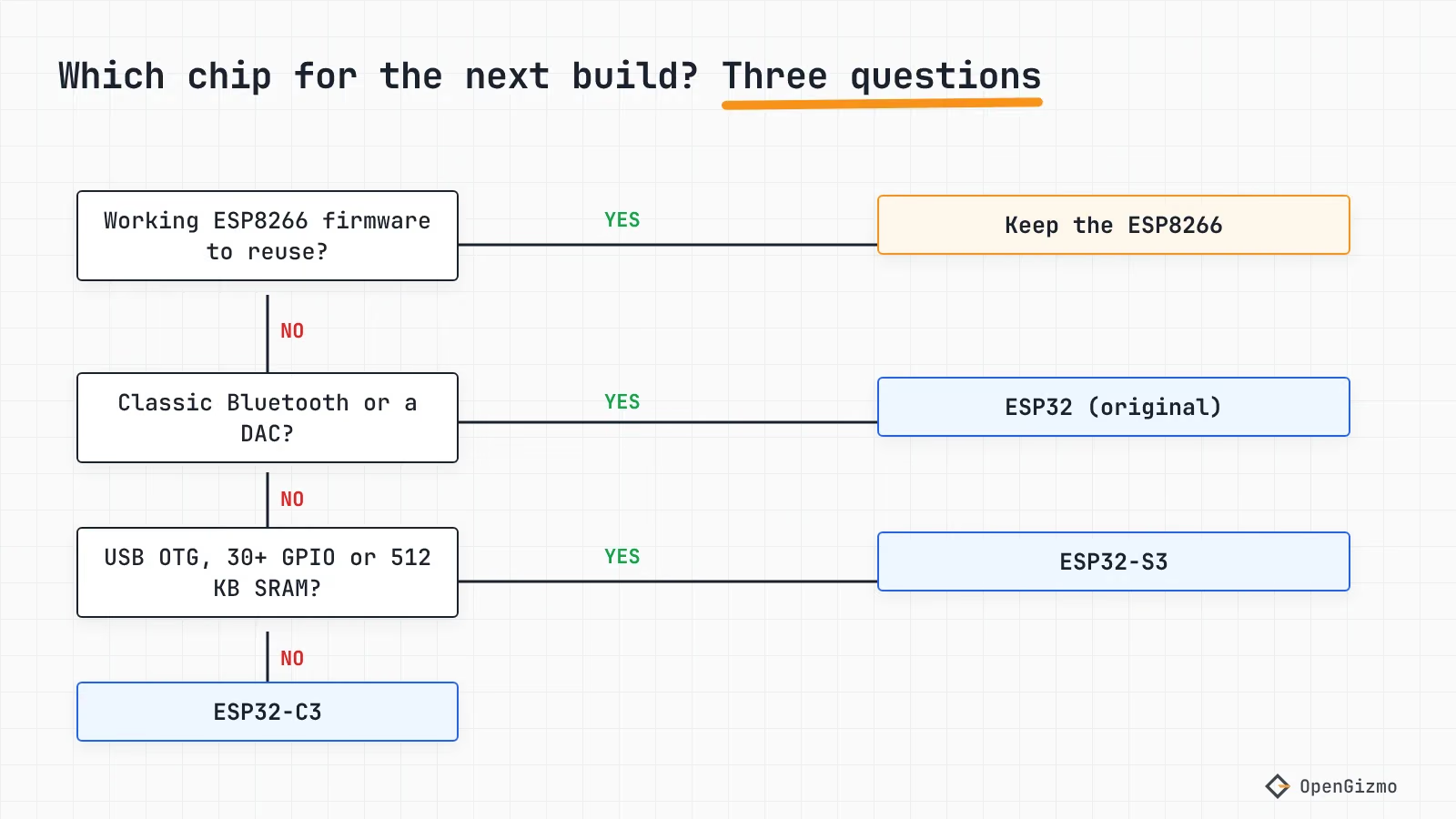
The short version: if you are starting fresh, the ESP8266 doesn't win any row of the spec table except, arguably, familiarity. The tree above covers the choice in three questions, and the limits are worth stating plainly. It assumes you're buying a board today; it says nothing about price, which I didn't verify; and the "keep" answer stops being right the moment you need a feature the chip doesn't have, such as Bluetooth setup, because no firmware tweak adds a radio.
The ESP8266 earned its place as the chip that made Wi-Fi gadgets cheap, and it will keep running the ones already built. For the next one, take an ESP32 family board. If you can't decide between the variants, read which ESP32 chip to buy, then see what the family looks like in practice in what the ESP32 is.
Frequently asked questions
Find quick answers to the most common questions about this topic.
The ESP32 has one or two Xtensa LX6 cores at up to 240 MHz, 520 KB of SRAM, 34 GPIOs, Wi-Fi and Bluetooth 4.2 with LE. The ESP8266EX has one core at up to 160 MHz, 17 GPIOs, one 10-bit ADC pin, Wi-Fi only, and under 50 kB of RAM for your program.

Author
Mauro BrambillaReady to build your own gizmo?
Pick an open-source ESP32 project and follow its step-by-step guide, from the parts list and wiring to the firmware and the first boot.